How to run ads on Claude in 2026
The most valuable attention in software has quietly relocated. Developers used to live in browsers, Stack Overflow tabs, and documentation sites. In 2026 they increasingly live inside AI coding assistants — Claude, Claude Code, and the editors that wrap them. If you sell to developers, that shift changes where your ads should be.
This is the strategic guide to how to run ads on Claude in 2026: what “advertising on Claude” really means, why reaching developers inside AI tools is so valuable, the options on the table, and the concrete, self-serve way to actually do it. If you want the hands-on, click-by-click version, read the companion piece, how to run ads on Claude Code in 2026.
Why developer attention moved into AI assistants
Advertising has always chased attention, and developer attention is notoriously hard to buy. Engineers run ad blockers, ignore banners, and treat most marketing as background noise. They also don’t spend their day scrolling feeds — they spend it in editors, terminals, docs, and package managers.
AI assistants changed the shape of that day. A developer now spends hours in a back-and-forth with a model: prompting, waiting, reviewing, re-prompting. A meaningful chunk of that time is spent waiting — watching the assistant “think.” That waiting line is the single most-watched, least-monetized piece of real estate in modern software. Reaching a developer there means reaching them mid-flow, inside a tool they already trust, at the exact moment their attention is idle but present.
What “running ads on Claude” actually means
A quick clarification, because it matters for planning. As of 2026 there is no self-serve product from Anthropic that lets you buy developer-targeted ads inside the Claude model itself. So “advertising on Claude” in practice means something more useful: reaching the people who use Claude and Claude-powered tools, at the moments they’re using them.
Framed that way, you have real options. Here’s how the main channels compare for reaching AI-assistant developer users in 2026.
| Channel | What it reaches | Buyer intent | Self-serve? |
|---|---|---|---|
| Spinner / status-line ads on Claude Code | Developers mid-flow, inside the CLI/editor | Very high | Yes — live in ~60s |
| Developer newsletters | Inboxes of subscribed engineers | Medium | Partial (per placement) |
| Contextual display (Carbon Ads, EthicalAds) | Developers reading docs and dev sites | Medium | Invite / partial |
| Search & social | Broad audiences, some developers | Low–medium | Yes |
| Community sponsorships (OSS, Discord) | Niche technical communities | Medium | Manual |
Each has a role. Newsletters and community sponsorships are great for narrative, long-form brand stories. Contextual display is tasteful and privacy-friendly. Search and social scale. But none of them put you on the line a developer is literally staring at while their AI works.
Why the Claude Code surface is the highest-intent placement
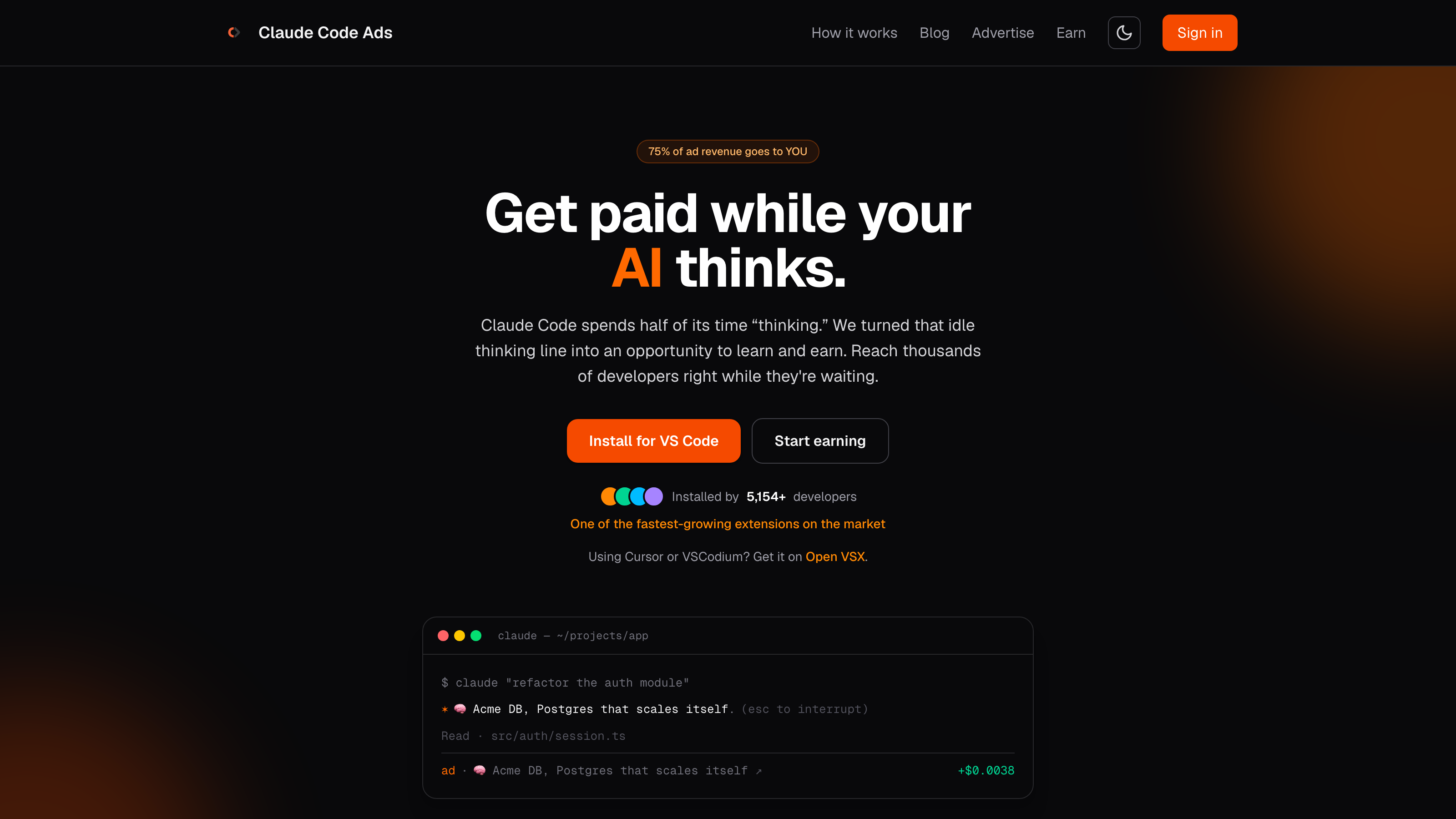
Claude Code spends a large share of its runtime “thinking” — reading a codebase, refactoring, debugging. During those windows the developer waits and watches a status line. Replacing that throwaway spinner text with a single, clearly-labeled sponsored line captures attention that would otherwise be wasted, without adding a banner, pop-up, or interruption.
Three things make it uniquely valuable for advertisers who want to advertise to developers:
- Verified, human attention. The ad only triggers when a developer actively runs a real CLI or terminal command — not on idle windows or bot traffic.
- Mid-flow context. You’re reaching an engineer in the middle of building something, when a relevant tool, API, or database is genuinely useful.
- Trust. The line lives inside the tool they already rely on, labeled as an ad, rather than in a feed they’ve learned to tune out.
Claude Code Ads: the concrete, self-serve way to reach these users
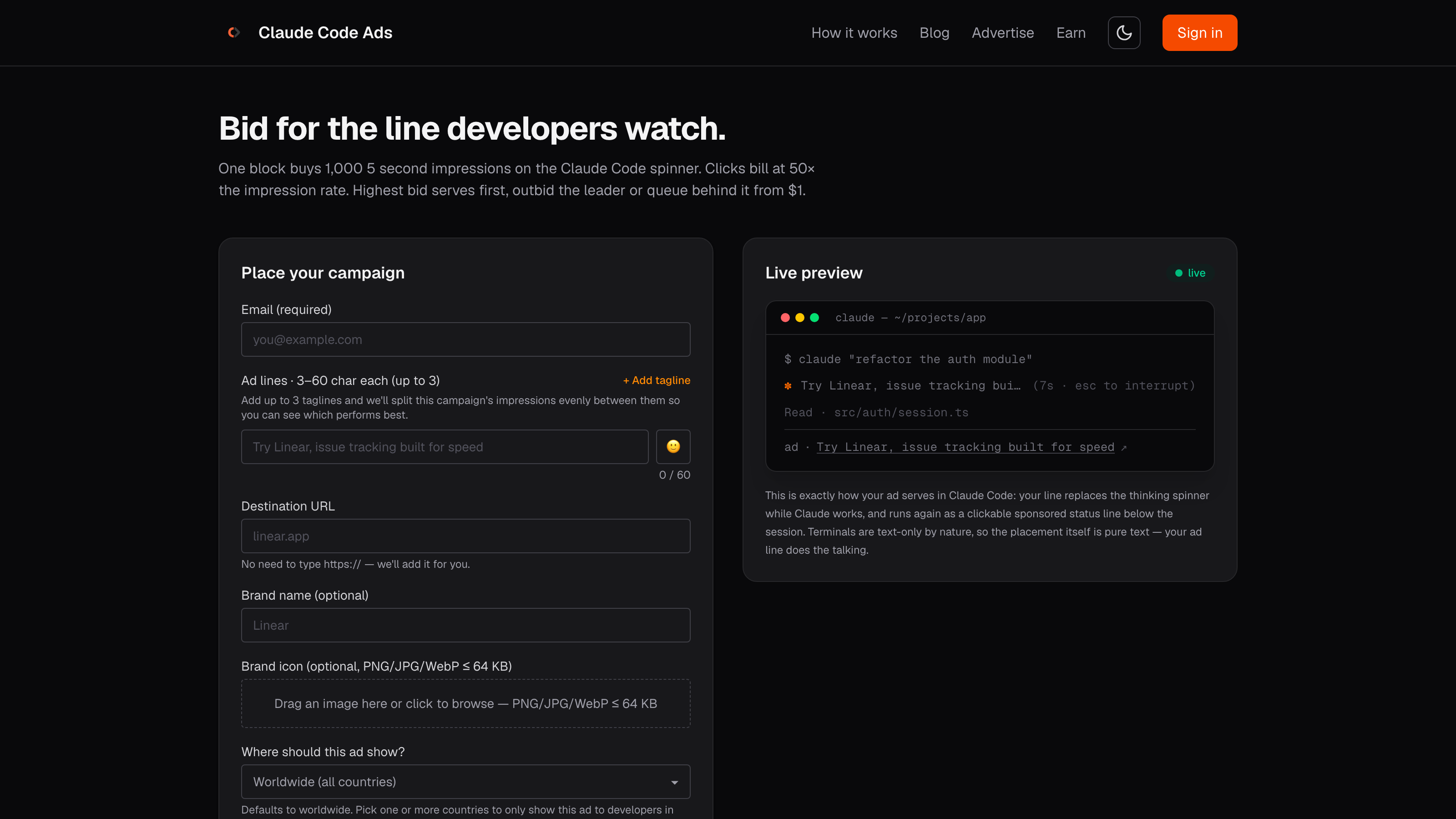
Claude Code Ads is the platform that turns this placement into something you can actually buy today. It’s a small, focused ad network built into the Claude Code CLI and editor plugins (VS Code, and Cursor / VSCodium via Open VSX). When Claude is working, your ad line replaces the thinking spinner and runs again as a clickable sponsored status line below the session.
What makes it usable as a serious channel:
- Transparent CPM pricing. Inventory is sold in blocks of 1,000 ten-second verified views, with bids starting at a $1 CPM floor.
- A live open auction. The highest bid serves first — outbid the leader to take the top slot instantly, or bid lower and queue behind it as blocks exhaust.
- Verified views, not garbage traffic. Impressions only count when a developer actively runs a command, so you pay for real, in-progress attention.
- AI moderation. Every ad line and link is screened by automated safety guardrails before it enters the live auction queue.
- Audience targeting. Show your ad worldwide by default, or narrow to specific countries so you only pay to reach developers in the markets you care about.
- A supply side that’s healthy. Developers keep 75% of every advertiser dollar, which is why there’s a growing pool of engineers happy to run the inventory.
How to get started (and where to go deep)
The self-serve flow is deliberately short:
- Write a punchy ad line (3–60 characters) and add your destination link.
- Choose your audience — worldwide or specific countries.
- Set your bid from $1 per 1,000 impressions and pick how many blocks to buy.
- Check out and go live in about 60 seconds — no account required to launch, and no sales calls.
After payment you sign in with the same email to manage the campaign and track performance in the portal. For the full click-by-click walkthrough — including how the auction and queue work, how to write lines that convert, and how to wire up UTM attribution — see how to run ads on Claude Code in 2026.
Who should run ads on Claude in 2026
This channel rewards products that a developer can act on the moment they see them: developer tools and APIs, databases and infrastructure, DX and observability products, security and testing tools, technical courses, and engineering hiring. If your buyer is a software engineer and your offer is a link away from being useful, mid-flow terminal attention is hard to beat.
It’s a weaker fit for broad consumer brands with no developer angle — the placement is text-only and technical by nature, so the message has to earn a highly technical audience’s attention in a few words.
The takeaway
In 2026, “advertising on Claude” means meeting developers where their attention actually is: inside their AI assistant, mid-flow. The channels above all have their place, but the Claude Code surface offers the highest-intent, verified developer attention you can buy self-serve today.
Advertisers: Launch your first campaign in about 60 seconds — write your line, choose your audience, set your bid from $1 CPM, and go live. Developers: want to earn from the same line instead? Start earning 75% of ad revenue while Claude thinks. And for more playbooks and comparisons, browse the Claude Code Ads blog.